
Elsje Christiaens
Volewijck
Out of Jutland’s thin light she came, a girl of eighteen winters, carrying nothing but hunger and the stubborn hope that Amsterdam might hire her hands.
The city received her as cities receive all who arrive penniless: with canals that glitter like coin and lodgings that demand coin before the first dawn. Elsje Christiaens found neither place nor wage. On the Damrak the landlady’s broom rose first—an ordinary instrument of household order—while the girl, cornered among her few rags, seized the axe that lay ready for kindling. One blow, a fall down the cellar stair, and the quarrel that had begun over unpaid rent ended in blood. A neighbor opened the door upon the noise; Elsje snatched a coat and linen from another lodger’s chest and fled, her garments already marked. She flung herself into the canal as if the black water might wash the deed away or finish it. Passersby dragged her out. Arrest followed, then confession, then the magistrates’ sentence, swift as the city’s commerce.
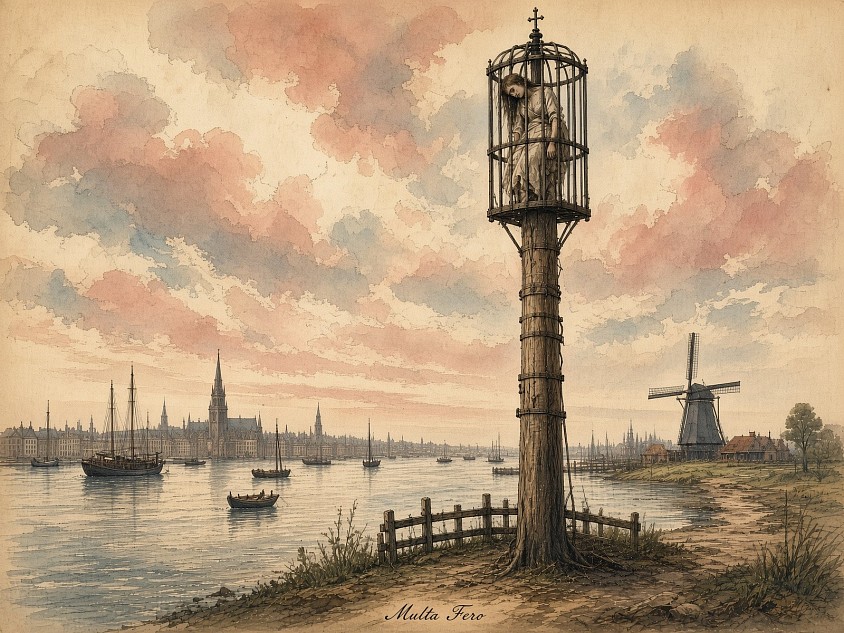
On the Dam, before the new Stadhuis whose stones still smelled of ambition, they bound her to the garrote. The same axe that had answered the broom now answered the law: several blows upon the living head, then the iron collar tightening until breath ceased. It was the first woman so punished in Amsterdam in twenty-one years; the square filled accordingly. Afterward they ferried the body across the IJ to the Volewijk, that low moor where the Republic hung its warnings for wind and crow to finish. There she hung, the axe fastened above her like a second, rusted halo, “to be consumed by air and birds.”
I watch him hire the boat.
Rembrandt van Rijn, fifty-seven, having already laid two wives and three children in the earth, crosses the same water that had tried to take the girl. He is not the crowd. He does not come for the lesson the city intends. He comes because the dead, for him, have always been a kind of light—yet this time, as one who later measured the sheet would note, he draws no living traffic around the corpse, no barge, no reed, no distant sail to remind the eye that the world continues. Only the post, the ropes, the slack weight of eighteen years, and the blade that named her crime. Two studies: one full face, one in profile. The hand that had painted Saskia’s breath and Titus’s childhood now records a stranger whose name the magistrates had already reduced to an example.
Anthonie van Borssom came as well, and set her among the other hung—men on wheels, pistols nailed above skulls, the whole grove of civic terror washed in pale color—so that Elsje appears as one note in a larger chord of punishment. Rembrandt isolated the note.
For a long while the drawings themselves were dated, by the fashion of the line, to 1655. Then Isabella van Eeghen, turning twenty-five years of confession books, found that no other executed woman had been displayed thus. The date locked to the first days of May 1664. The girl who had been raised as a warning against crime became, three centuries later, a warning against the pride of style: the hand can lie about the year; the archive does not.
So the Eternal Observer keeps both ledgers open: the broom and the axe, the canal and the gibbet, the painter who had buried his own and the Danish maid who would have none to bury her. Amsterdam counted her as deterrent. The paper counted her as presence. Between those two reckonings the body hangs still, neither wholly example nor wholly portrait, a brief life stopped at the exact point where poverty, rage, and the city’s iron law met—and where an old man with a pen chose, for once, not to set the living world back into the picture.
