
Geertje from Edam
1643 - 1646
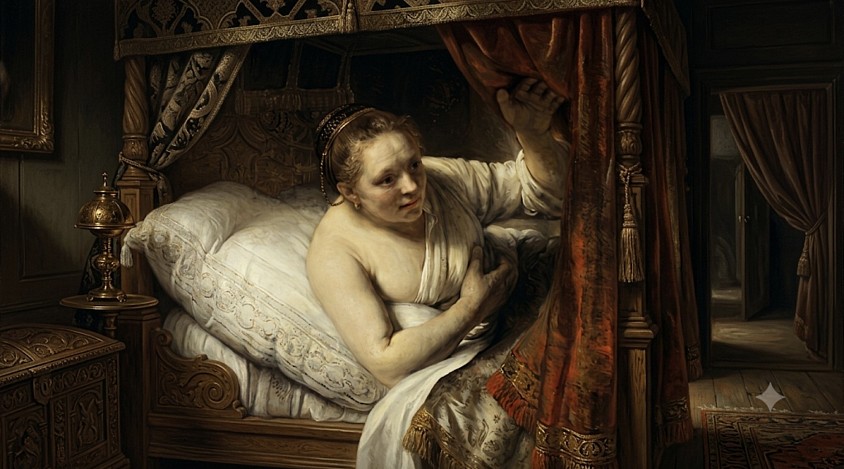
Woman in Bed (1645)
From the long silence after thunder the Seer now draws a single, measured vigil of one house and its light.
I keep the watch upon a single house in the Sint-Anthonisbreestraat—a grandeur of brick purchased for thirteen thousand guilders that hangs about its owner like a golden millstone. Fourteen months after Saskia’s burial in the Oude Kerk, the laughter is gone. In its place rise the soft complaint of a child not yet two, the practical tread of Geertje Dircx, dry-cooper’s widow from Edam, and the ceaseless scrape of needle upon copper.
Rembrandt moves through these rooms like a man struck by lightning yet still walking. The Night Watch finished, he turns inward to smaller, denser work—the copper plate, the press, the long silence after loss. Geertje stands in the kitchen with Titus against her hip, Saskia’s ring flashing as she feeds the heir. Her thought moves like a slow current: the ring is both gift and chain; she is no Frisian heiress, only the widow of a sailor who never returned—nurse, lover, temporary warmth against death’s cold. She will not ask.
Rembrandt takes the child, feeling the living weight of all that remains of Saskia’s blood. The will of the fifth of June stands between him and remarriage like a drawn sword: marry and the fortune passes wholly to Titus; remain unmarried and the usufruct is his. A just law, yet cruel. Their eyes meet in unspoken recognition of living and dead, high and low, artist and the woman who entered as servant and remained something more dangerous.
In the studio the air smells of acid, ink, and damp paper. Young Samuel learns that the master teaches mercy, not merely light and shadow. Rembrandt works a landscape plate where storm and sunlight contend across three trees, a fisherman dissolves into bank, lovers hide in bushes. The copper itself mirrors the soul: acid bites, drypoint raises fragile burr that prints richest in early pulls before the world flattens it. He does not fight the wearing; he records it.
A bound sow receives denser soul than the children who play nearby. On oak, Bathsheba sits contemplative, garter-mark unidealised, David watching from afar. Later he raises a temple no larger than a strongbox: the Woman Taken in Adultery kneels in purest white while Pharisees emerge from shadow. Geertje asks if size measures the soul. Rembrandt answers that the wall held muskets; the panel must hold God and one kneeling woman. Titus sees the sadness before the sin. “She is sad,” the father says. “And the light is looking at her.”
Holy Family, Girl at a Window, Abraham and Isaac, the Adoration of the Shepherds with its dual radiance—lantern of earth, light from the Child—fill the seasons. Court payment of twenty-four hundred guilders eases the mortgage for a time. Yet the house remains a temple mixed with compromise: the painter pursues invisible light, the woman keeps the visible day, the child sleeps between them.
I remain in the corner beyond lamplight. The largest walls may hold only a moment’s march; the smallest surface opens into the infinite. Light continues its ancient labour of revealing both the gold of the altar and the dust upon every human threshold.
