
Against the Silence
1663 - 1666
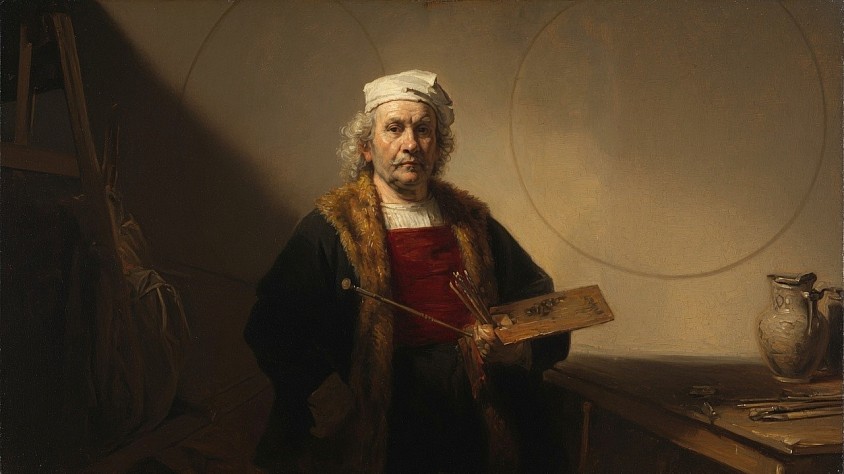
Self-Portrait with Two Circles (1665)
I set these three years—1663 to 1666—upon the anvil: iron that must become sword or shatter.
Europe still wears a crown that already slips. A young French king gathers every ray of power into one intolerable focus. England laughs through a Restoration fever. The German Empire drags wounded bulk across forgotten fields. Spain counts thinner silver. The Crescent presses until St. Gotthard grants a breathing-space Christendom will squander.
In the north the Dutch Republic prices eternity in guilders. East Indiamen come home like floating continents. Amsterdam, two hundred thousand souls, flings out canals and twenty-six bastions. Then the counter-stroke arrives in a rat, a flea, a sailor from Smyrna. In 1664 the pestilence reaps twenty-four thousand. Funeral barges jostle spice barges. A comet scars the winter sky.
In a narrow house on the Rozengracht—opposite the public maze, far from the lost palace on the Breestraat—Hendrickje Stoffels dies in July 1663 and is carried to a rented grave that costs ten guilders and thirteen stuivers. Rembrandt remains with Titus, twenty-two, already the ledger’s wall, and Cornelia, nine, who watches dust dance in the slanting light.
He raises ridges of gold on Homer dictating into darkness for distant Ruffo. He sends Frederick Rihel riding through a city of sealed doors. By candle he paints himself as Zeuxis, laughing at the grotesque until the laugh becomes defiance. In 1664 he crosses the Y to draw Elsje Christiaens hanging with her axe, then turns the same gaze upon Lucretia’s quiet dagger. A couple’s hands claim one another in thick gold and crimson—Isaac and Rebecca, or any two who stay when the world says part.
War does not wait. England seizes New Amsterdam and names it New York. Lowestoft is a Dutch Golgotha; the Four Days’ Battle a resurrection paid in blood. London is first emptied by plague, then purified by fire. The market for pictures contracts. Claudius Civilis is rejected and cut down.
In 1665 the insolvency closes. Titus, now of age, holds the remnant of Saskia’s estate like a thin wall. Gerard de Lairesse sits for a face the master will not idealise; the sitter will one day call such work liquid mud. The last etching is cut for a Leiden physician. In 1666 Lucretia’s chemise deepens its stain; the Prodigal’s father begins to open two hands of mercy; modelli for Genoa leave on a ship that never arrives.
Reader, the air is heavy with spices and lime, hammers finishing walls that will not keep death out, brushes finishing faces death has already claimed. The century shows its double face: the face that builds and the face that buries. The hand still raises the light. The bells still count the dead.
