
Apprentice Eyes
1627 - 1630
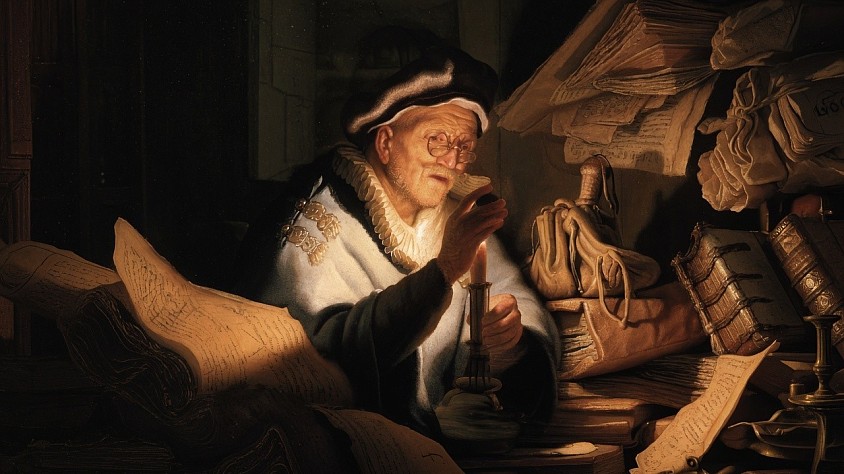
Parable of the Rich Man (1627)
I, the Seer, who have watched empires rise and fall now fix upon a miller’s son in Leiden, around 1620, whose hand would one day compel light to yield its secrets. Flour still clung to Rembrandt’s sleeve as he entered Jacob van Swanenburgh’s studio. His parents had hoped for Latin school and university, yet they yielded without bitterness when the boy’s charcoal drawings proved stronger than Virgil. The mother’s silent release and the father’s measured farewell marked the first quiet surrender of ambition to a greater calling.
Inside the workshop thick with linseed and ochre, classical casts stood under thin northern light. The youth learned proportion and obedience, yet already tilted candles and shutters to carve sudden half-shadows across faces. A dockside model named Klaas felt the light’s bite and muttered of the devil; Rembrandt answered only in thought: let the darkness confess what light alone cannot say. By the third year the grammar was absorbed and found insufficient. He must break the rules he had first mastered.
In 1625 he boarded the trekschuit for Amsterdam, drawings under his arm, to study with Pieter Lastman, then the city’s foremost history painter. The denser streets, taller gables, and restless commerce met him as both invitation and trial. Under Lastman he absorbed Italianate staging, then began to concentrate light into single dramatic sources, letting large areas fall into expressive shadow. Private mirror grimaces and tronies became laboratories of pure emotion. Gesture rose from inner pressure, not classical code.
Thus the miller’s boy became the young master whose lifelong war of light and darkness had already begun.
