
Moving Out!
1655 - 1658
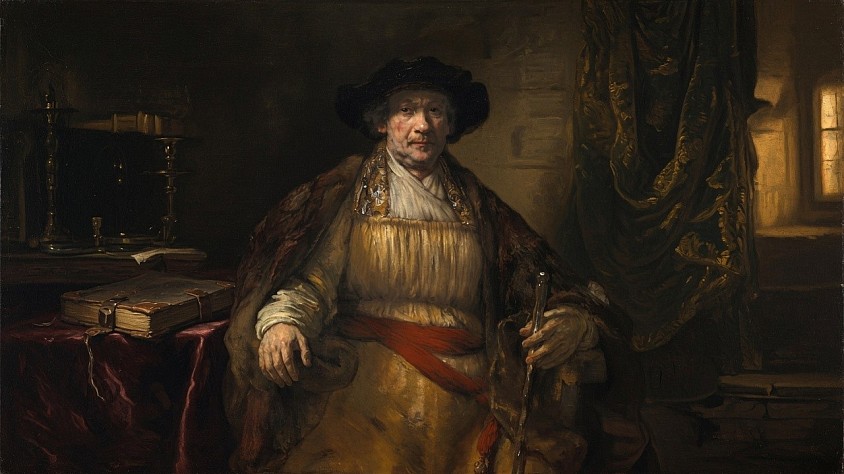
Self Portrait (1558)
I, the Eternal Observer, who once leaned on the salt-blackened rails of Indiamen still breathing nutmeg and unspent ocean, and who stood unseen among the tapestries of Holland as Westminster’s last clauses fell like a verdict, speak now of the Republic swollen with gold yet still reeking of pitch and unpaid blood, hung between dominion and its own secret fracture.
The English war sleeps. Peace is only war in changed garments. Johan de Witt treats the State as a theorem; four-year-old William is excluded from the stadtholdership like a storm from a calculation. Warehouses along the IJ swell with pepper, silk, indigo. On the Dam a new Town Hall climbs from thirteen thousand piles—a temple raised not to God but to the ledger.
A few streets east, on the Sint-Antoniesbreestraat, the same century wears another face. In the house bought for thirteen thousand guilders in 1639, Rembrandt still wrestles with light as the Republic wrestles with power. The window that once framed Saskia now frames Hendrickje. In 1654 he paints Jan Six; that October Cornelia is born and the consistory names the mother’s sin. The mortgage has long ceased to be paid.
Frost grips the panes in 1655. He stands before the hanging ox, sleeves rolled, carmine smeared on his hand, turning flayed flesh into a cathedral of substance. Titus, fourteen, sits at the lectern. Hendrickje moves between stove and cradle. The sealed paper from the Chamber curls on the mantel. “Tell them the house is Titus’s now,” Rembrandt says, still facing the panel.
Summer 1656: he assigns the deed to his son, then petitions for cessio bonorum. Frans Bruijningh inventories plaster hands, coral, busts, Brouwers, while Rembrandt glazes Jacob Blessing the Sons of Joseph and the brutal foreshortening of The Anatomy Lesson of Dr. Deyman. They number what love cannot be reduced to guilders.
Winter 1657 empties the rooms. He paints Bartholomew with the knife already present and Catrina Hooghsaet with her living green parrot. At the Keizerskroon the hammer falls on prints and Japanese armor.
February 1658: canal mist veils the departure for the narrower house on the Rozengracht. Titus and Hendrickje become the dealers; Rembrandt is listed only as employee. He paints himself seated in gold, staff in hand—a throne no creditor can seize. The light that once flooded the great atelier now concentrates through one high window, fiercer for its restriction.
The shells are counted, the ledgers closed, yet the next stroke remains. Destiny arranged the contrast with a dramatist’s precision: finite inventory beside infinite canvas. The house passes; the family moves; the works endure. The light does not recognize the Desolate Boedelskamer.
