
Still Painting
1559 - 1662
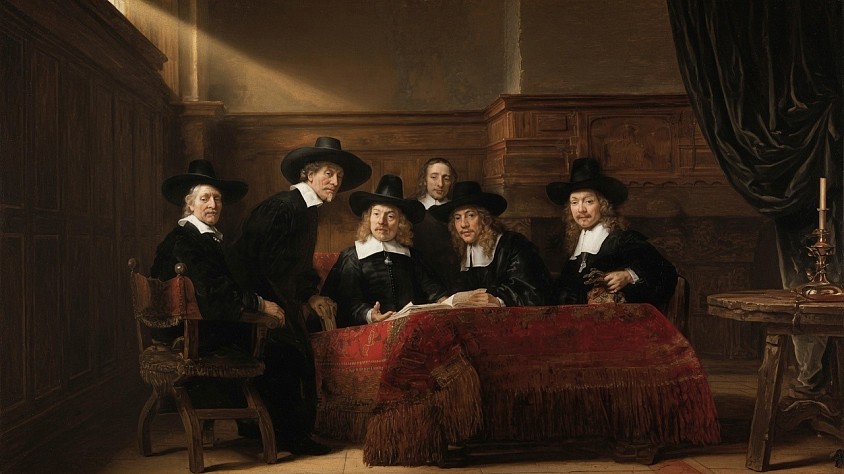
The Syndics (1662)
Dust of 1662 settles on the Rozengracht while the Eternal Observer records both republic and rented room.
I stand outside the years yet enter their dust. The United Provinces still rest on Johan de Witt’s spare architecture of True Freedom: no stadholder, only ledgers and interest. The scar of 1650 sleeps; Orange hunger drinks from the same earth as liberty. Across the sea England already composes the next war in silence. Louis XIV studies the Low Countries as a map he means to own. Plague breathes in distant cities. Huygens measures time into pitiless units while the heart keeps none.
Rembrandt no longer walks the Sint-Anthonisbreestraat as king of shells and casts. He rents rooms opposite the Doolhof. In December 1660 Titus and Hendrickje become the firm; he is their employee. Every future canvas belongs to them. The master signs his work away for board and a small allowance.
He stands before the unfinished Syndics. Five sampling officials look up as if a door has just opened. Paint is scraped and rebuilt; light is cooled on a cuff. The same hand that once etched Peter healing the cripple and faced the 1659 mirror now loads the brush with reckless breath. Nearby the vast Civilis—nocturnal oath, one-eyed leader, barbarous grove—has already been taken down from the Town Hall lunette. Ovens fills the space with approved virtue. Rembrandt will cut the canvas himself so a fragment may survive.
Hendrickje, thinner each week, sets bitter steam beside the easel. Cornelia watches the painted men who look back. Titus unfolds Ruffo’s salt-stained letter: seams too visible, Homer half-born. The son answers courtesy with calculation.
A messenger arrives: the treatment is insufficiently elevated. Rembrandt does not change expression. “Tell them I will receive it. A fragment that still speaks is better than silence imposed by those who fear the full speech.”
Evening comes. They sit by the hearth. One canvas will hang for generations; the other will be sawn. Destiny tips the scales twice. The canal converses with brick. A last ridge of paint holds candlelight on a forehead that refuses to look away. Ledgers of nations and of one soul are written in the same ink. Reduction strips the ornament and leaves the hand. The light still chooses the human face.
